Elevating Internal Feedback Experience
Paintings series capturing the timeless essence of the Sonoran Desert through its shifting landscapes. This project explores the subtle relationship between light, iconic geological formations, and the plant life that defines this unique ecosystem. Through a soft and contemplative palette, the series invites reflection on the silent beauty and resilience of these arid lands.
Role
Lead Designer
Timeline
4 Months
Team
1 Designer + 2 Developer
Tools
Figma, Shesha

OVERVIEW
Turning Developer Chaos Into Clarity: Building Shesha's First In-App Feedback System
When one is used to a certain way of working, introducing change can feel almost impossible. At Boxfusion I was tasked with bringing a major shift to our development process: helping engineers code faster. Not an easy feat.
Every company works differently, and it becomes your responsibility as a designer to drive meaningful change.
Boxfusion engineers had been using DevOps and other external tools to report feedback on each project. But because Shesha became our core framework for building applications, there was no way to give feedback directly on a specific configuration form inside Shesha. This caused delays, inefficiencies, and unnecessary outsourcing costs.

IMPACT
Achievements
15% reduction in company costs by eliminating external tool dependencies
Faster feedback loops, engineers can now report issues without leaving Shesha
Improved cross-functional alignment through clearer design handoff
PROBLEM
From Bottlenecks to Breakthroughs: How I Redesigned the Engineering Feedback Loop
Engineers were context-switching between Shesha and external tools just to report bugs or suggest improvements. This workflow fragmentation slowed development and increased costs.
I needed to deliver an in-house tool fully compatible with Shesha that allowed engineers to give direct, contextual feedback on configuration forms.
My goals:
Capture User Trends
Understand how developers previously captured and shared feedback
Competitive analysis
Research tools that align with our desired outcome
Solve the Problem
Design a feedback system inside Shesha that enabled developers to collaborate faster and reduce friction
APPROACH
Shifting the Way We Build: Designing a Feedback Engine Inside Shesha
It was clear early on that Shesha had the capability to support an internal feedback system. From the start, I worked closely with developers and collaborated directly with the VP of Engineering who was leading the initiative.
Together we mapped out key pain points with the old feedback process. These findings shaped the foundation of the system and highlighted which elements needed to be prioritised in the design.
Research approach:
• Shadowed engineers using the current external feedback tool, gathering clear expressed pain points.
• Conducted comparative analysis of feedback tools (Jira, Asana, Linear, and our current system)
• Mapped the existing workflow to identify friction points.
While the VP created the core user flow, I conducted extensive research into a variety of feedback tools, including the external one our teams were currently using. Despite their differences, most tools shared a simple flow that prioritised clarity, visibility, and ease of use.
Key insight: The best feedback tools make capturing context effortless — screenshots, annotations, and issue tracking should happen in one place, not three.
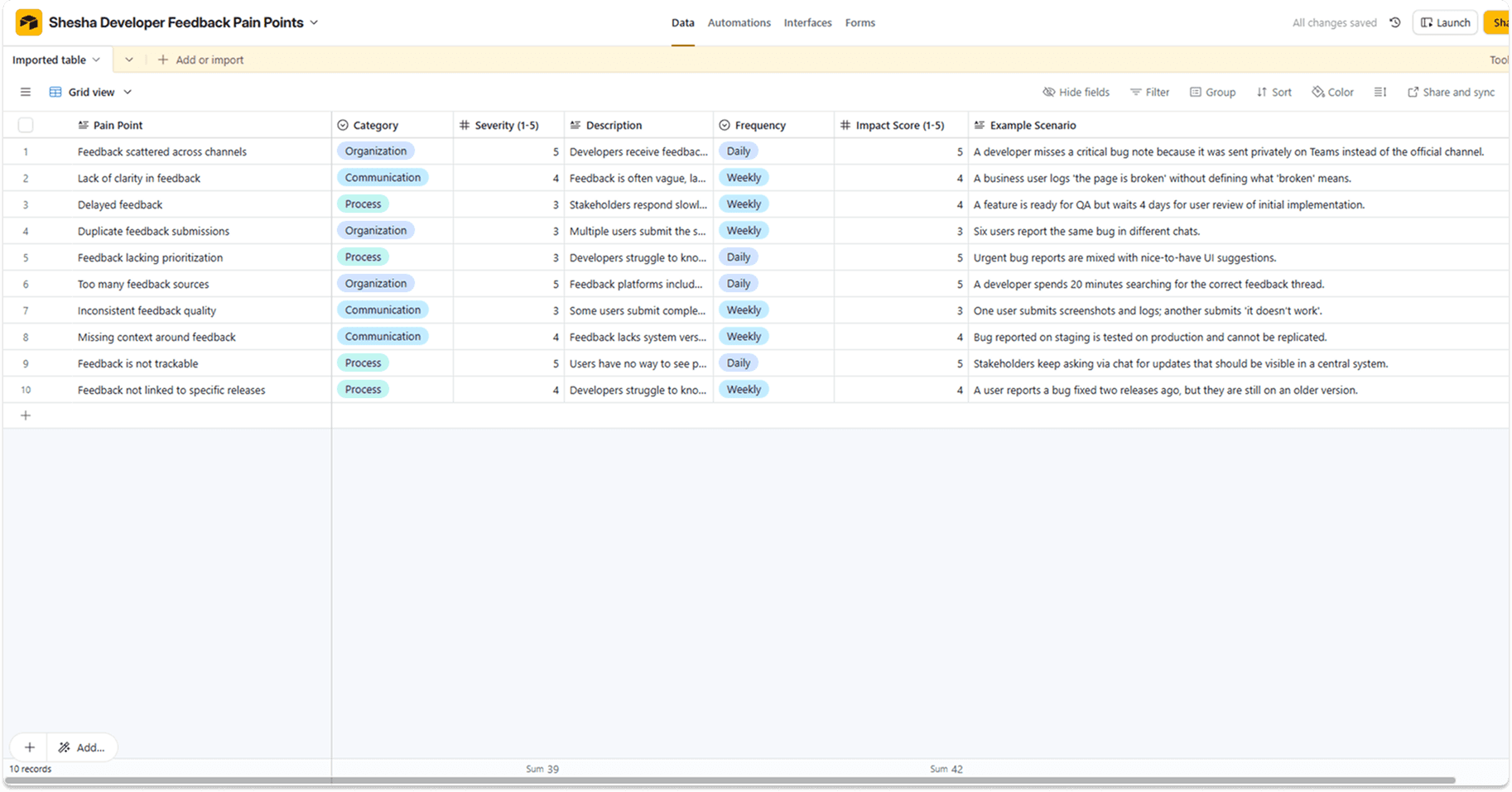
Mapping the chaos of developer feedback. This Airtable research breaks down fragmented feedback patterns into clear, prioritized insights

A comparative analysis of feedback tools, Jira, Asana, Linear, and Heurio. Mapping key capabilities across feedback features, workflow, and UX to inform the design of a new feedback tool for the Shesha team.
SOLUTION
Fixing Feedback at the Source: Creating a Faster Workflow for Boxfusion Engineers
Once my analysis was complete, I began designing in Figma. My goal was to create an experience that felt simple but still carried the modern design language that the Shesha framework supports.
I had contributed to designing the Shesha design system, so I relied heavily on the component libraries and visual tokens we built to ensure consistency and streamline the build.

First Iteration: Designing the Missing Piece
The first feedback iteration was well received and moved into development. But once we tested the built system, we noticed large inconsistencies in layout, spacing, and component sizing. This was frustrating, especially because we had intentionally used Figma Dev Mode to avoid exactly these issues.
After aligning with the development team, we discovered the issue stemmed from internal personnel changes. Multiple managers had provided input at different stages, which led to misalignment.

Bringing the Team Back Into Sync
To resolve this, I organised a session with the VP, PM, and the developers to realign on the final design. We reviewed every decision, walked through every screen, and made sure everyone had the same understanding of how the tool should be built.
From that point on, we operated as one centralised team with clear direction.

CONCLUSION
Key Takeaways
This project was a strong reminder of the importance of clear communication and cross-functional collaboration. Not every project follows a smooth path, but as a designer your ability to adapt and realign is essential.
I learned how to navigate unexpected changes while still advocating for good design.
The lesson? When things go sideways, bring everyone into the same room (literally or virtually) and walk through the work together. Alignment beats assumptions every time.