UX Design
Mobile App
AgriTech
Designing for
Africa’s
Modern
Farmers
A full end-to-end UX design project — from research and wireframes through to a polished iOS app helping African users manage there farms through smart design.

ROLE
Lead Designer
TIMELINE
8 Weeks
TEAM
Solo + 2 Devs
TOOLS
Figma, Balsamiq
OVERVIEW
SmartAgri: Product Vision
FarmSwitch is the heartbeat of Smart-Agri Africa, a revolutionary Software-as-a-Service (SaaS) platform designed to empower farmers with next-level planning, management, and monitoring capabilities. Think of it as your 'Farmer in a Box,' providing you with the tools and insights you need to maximize yield and minimize risk.
IMPACT
Achievements
The first iteration of task related functionality of the app was launched. An 13% increase in task completion for onsite farmers, than when previously executed through paper and word of mouth systems.
Designs were used in gaining more shareholder funding for the company, gaining an 7% increase in funder revenue since positive feedback from relevant farm networks that used the app.
Enhancing Visual language and easy use of usability on the mobile version, improving user complaints.
PROBLEM
The Challenge: Digitising African Agriculture
A paperwork based system still rains supreme in the African Market of farm management. This is due to several reasons but a main one is poor investment in technological efforts. The client observed the needs in farming largely vary in its functions from every farm which demands a system that can be widely used by all farmers regardless of the kind of farming they are doing.
The Key challenges in developing this product:
Defining the product roadmap to include all the key functionality yet making it easy to use and affordable for small farmers.
Designing an architecture that incorporated many diverse activities after an elaborate process of discovery.
Creating a front-end design that provided scalability and data-driven UI Integration for both mobile and web.
APPROACH
Designing for Simplicity at Scale
I understood the requirement for a solution that is very simple and easy to use by all kinds of farmers and designed a farm management software with an elaborate architecture that includes every farming specific activity as described by the client. We also needed to include and align with other important third party members that make up the overall system that is embedded in the agricultural space. Those included the Funders and the off takers.
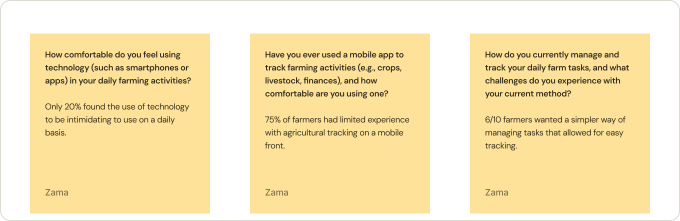
Having a close contact into the world of African Agriculture in the help of real world farmers through Smart Agri. Our team found a smooth journey in getting a deeper understanding into the needs of the farmers that our client wanted to support. I conducted user interviews on the team of SmartAgri farmers to further fledge out the initial requirements that were gathered by the business analyst on our team.
Based on these discussions we found:
Our approach included:
Designing a dashboard to give a quick overview of the farm with a high level status on different activities, crops, locations, fields, tasks and inputs.
Designing the task flow that a farmer would undergo. That included a high level task overview, task details, task actions: update & create.
The team understood that the initial scope was to start small and gradually build up to more high level aspects that can span and reach an even wider market in the African agri space.
SOLUTION
Redesigning the Farmer Dashboard
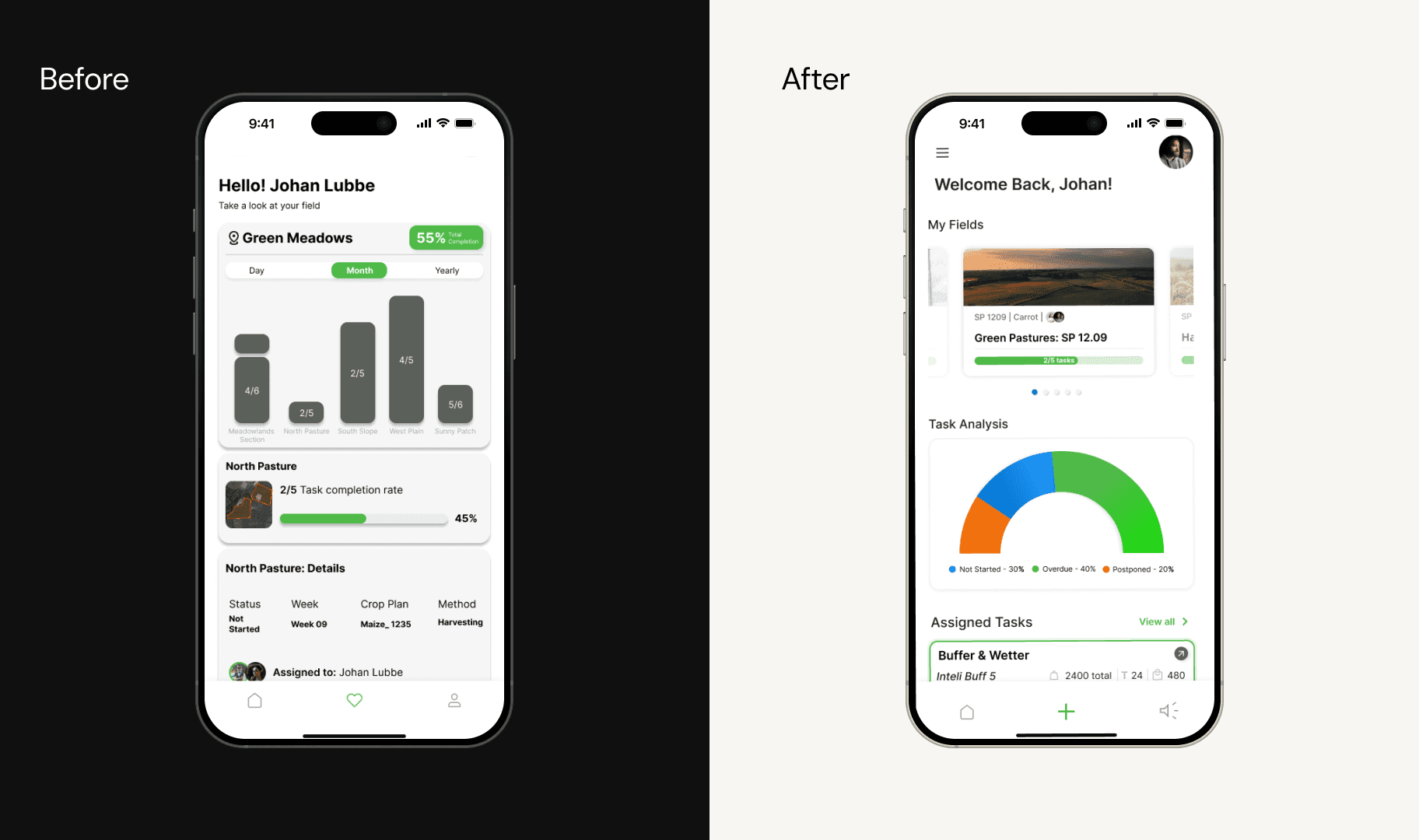
The dashboard was the first view that any farm user would undergo. The farmer would use the dashboard to make informed decisions on the fields they are working on, the tasks that have been assigned to them, relevant crop and input information.
Upon user testing feedback we found that the farmers were overwhelmed with the overall view of the dashboard and wanted to focus more on the assigned tasks, fields and a simple task analysis.
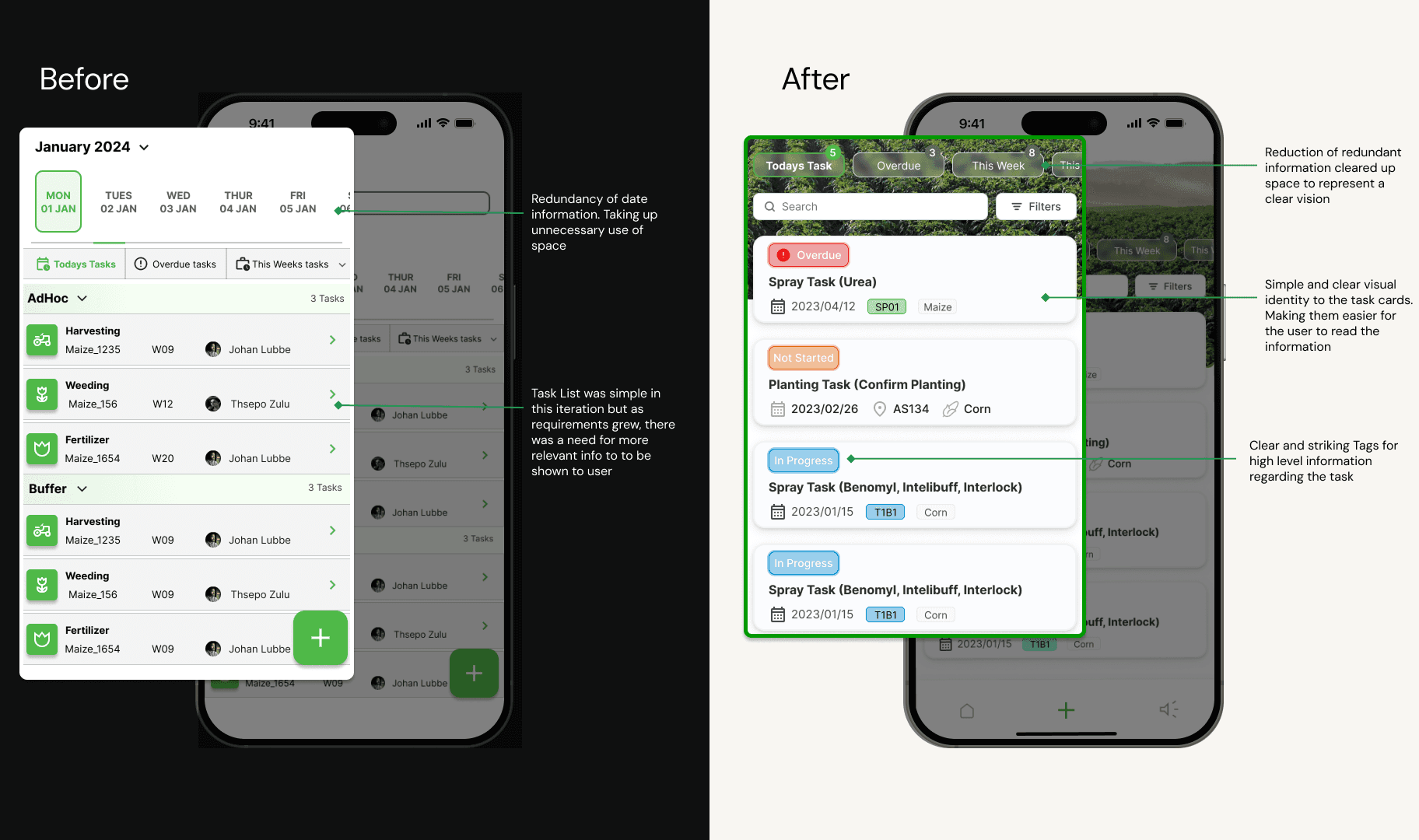
2. Reducing Cognitive Load in Task Management
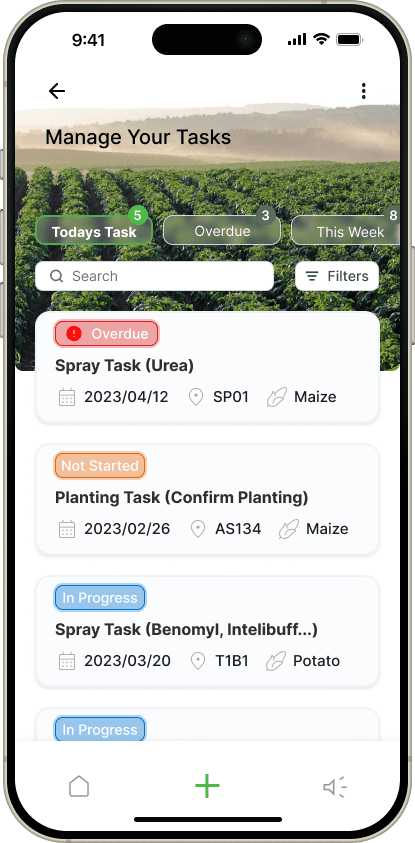
Based on the requirements gathered by our team of Business Analysts I found that the task information was fairly extensive in the details that a farmer needed to know in order to fulfill. This caused the initial design to cause cognitive load on the developers and unnecessarily clutter the UI of the app.
With the help of A/b testing on the important variable that was the task list card. This enabled me to come up with a concise view to the task list that not only helped in the cognitive overload for the developers but a simpler view for the farmers too.
3. Iterating the Task Detail Experience
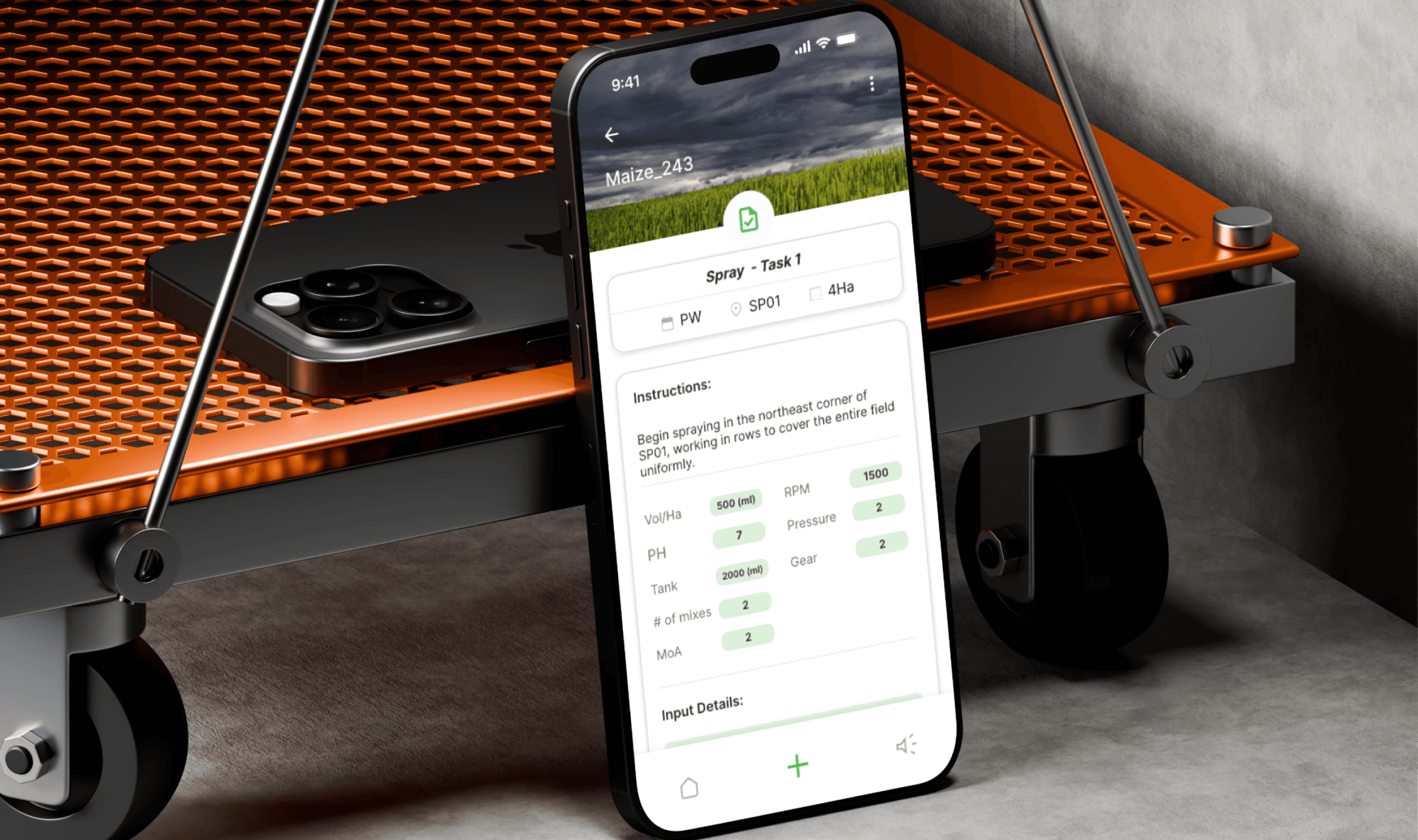
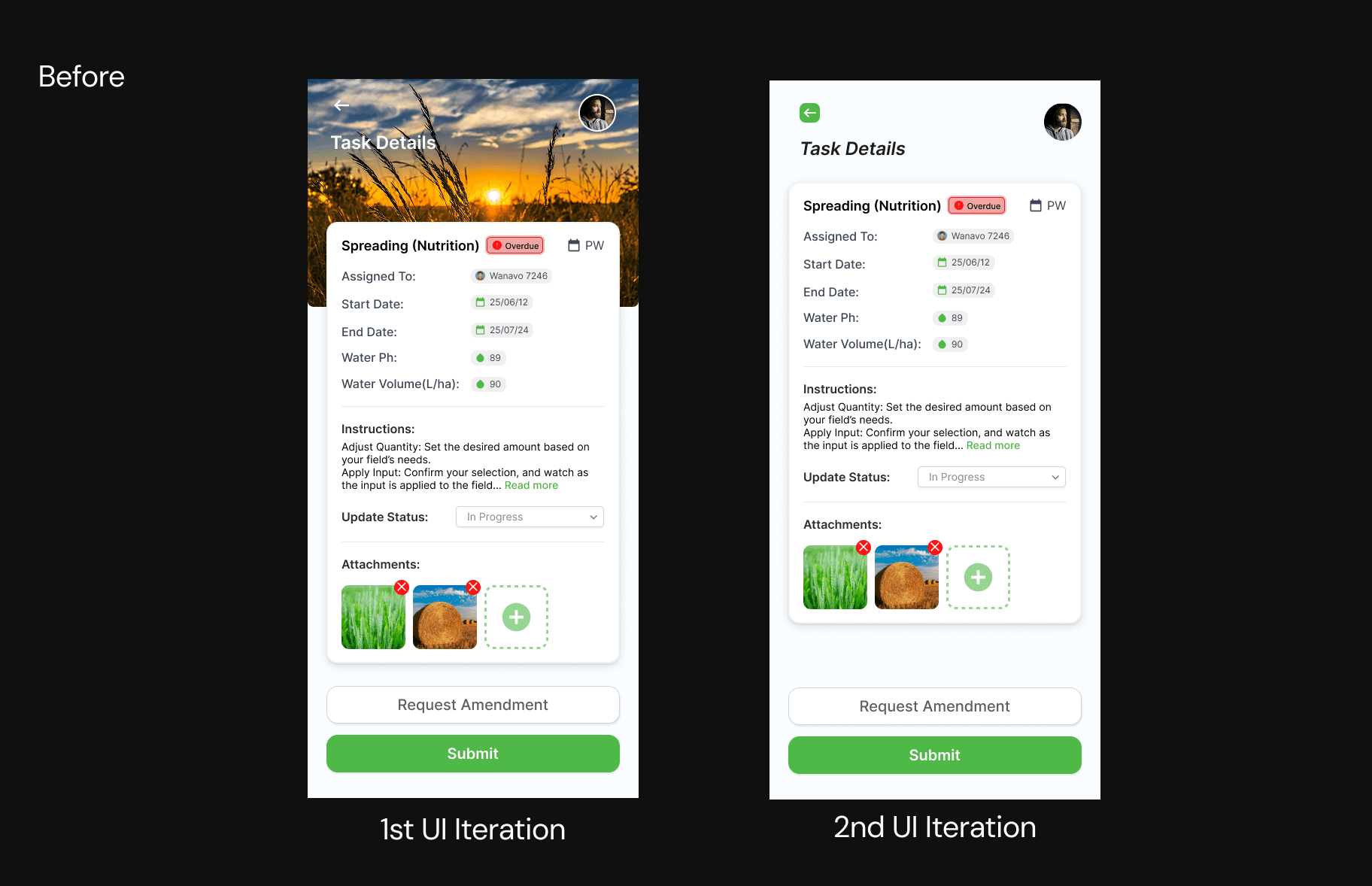
The task details page is the main purpose of the application: where onsite farmers get clear instructions on fulfillment of the task, important input details that inform the management of crops, and submitting proof of task completion, as well as task actions.
This page underwent multiple iterations due to the high volume of information that needed to be relayed to the farmer. It was important for me to keep the designs simple and visually clutter free as multiple user actions were going to be handled on this screen.
CONCULSION
Key Takeaways
Design is long road that takes many turns.
The road to completing our ultimate goal is still in development, and many steps are being taken to get to the finish line of our product. The impact on the first iteration was a perfect eye opener into the development of building an app that is setting out to make a real world impact on the ever growing agriculture space in Africa.
As a designer, making these strides in a space that is so far removed from my everyday landscape, helped me get a better understanding of an important industry that has an immense impact on the continent as a whole.
NEXT
Shesha Feedback Tool
Internal Tool | 2024
NEXT
Shesha Design System
Design System | 2024
UX Design
Mobile App
AgriTech
Designing for
Africa’s
Modern
Farmers
A full end-to-end UX design project — from research and wireframes through to a polished iOS app helping African users manage there farms through smart design.
ROLE
Lead Designer
TIMELINE
8 Weeks
TEAM
Solo + 2 Devs
TOOLS
Figma, Balsamiq
OVERVIEW
SmartAgri: Product Vision
FarmSwitch is the heartbeat of Smart-Agri Africa, a revolutionary Software-as-a-Service (SaaS) platform designed to empower farmers with next-level planning, management, and monitoring capabilities. Think of it as your 'Farmer in a Box,' providing you with the tools and insights you need to maximize yield and minimize risk.
IMPACT
Achievements
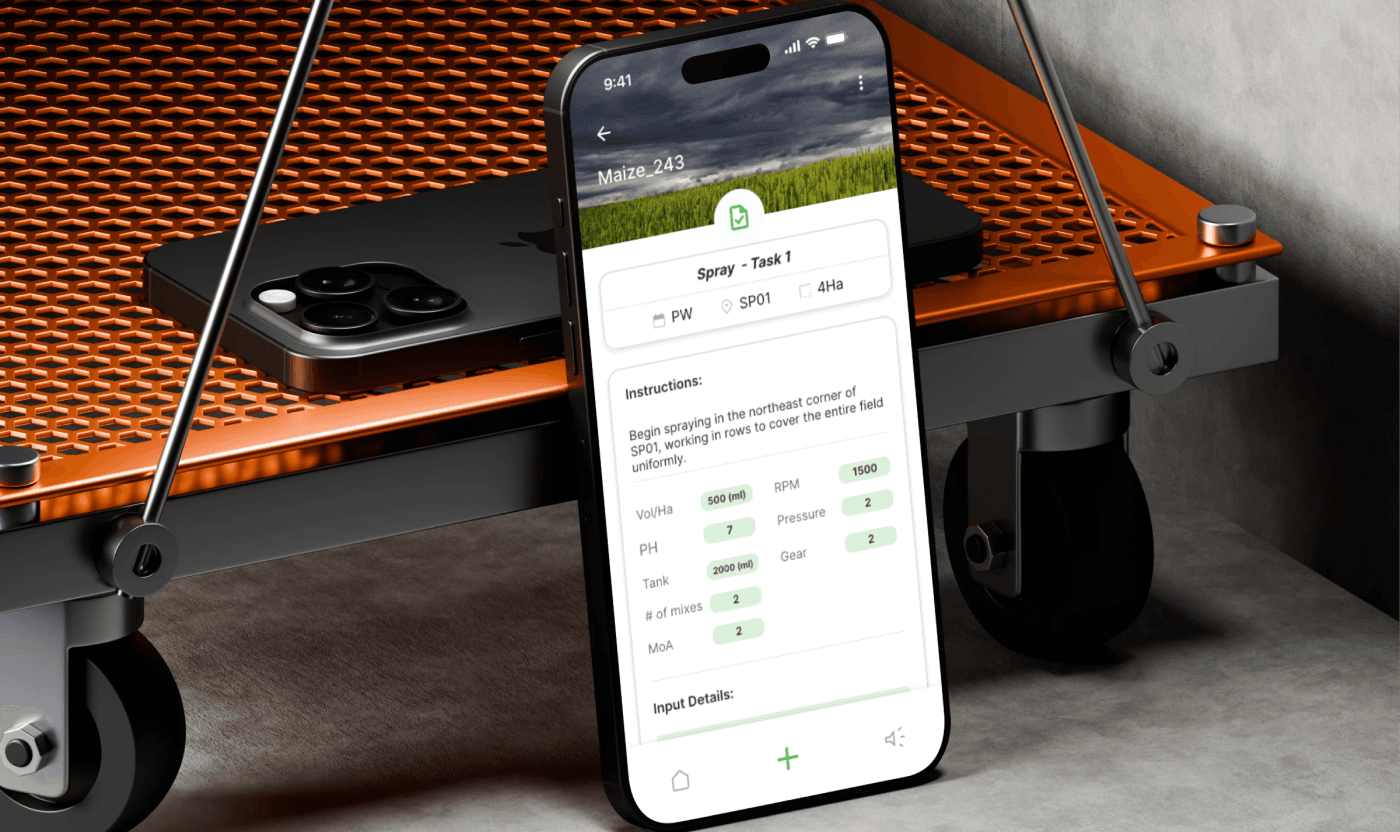
The first iteration of task related functionality of the app was launched. An 13% increase in task completion for onsite farmers, than when previously executed through paper and word of mouth systems.
Designs were used in gaining more shareholder funding for the company, gaining an 7% increase in funder revenue since positive feedback from relevant farm networks that used the app.
Enhancing Visual language and easy use of usability on the mobile version, improving user complaints.
PROBLEM
The Challenge: Digitising African Agriculture
A paperwork based system still rains supreme in the African Market of farm management. This is due to several reasons but a main one is poor investment in technological efforts. The client observed the needs in farming largely vary in its functions from every farm which demands a system that can be widely used by all farmers regardless of the kind of farming they are doing.
The Key challenges in developing this product:
Defining the product roadmap to include all the key functionality yet making it easy to use and affordable for small farmers.
Designing an architecture that incorporated many diverse activities after an elaborate process of discovery.
Creating a front-end design that provided scalability and data-driven UI Integration for both mobile and web.
APPROACH
Designing for Simplicity at Scale
I understood the requirement for a solution that is very simple and easy to use by all kinds of farmers and designed a farm management software with an elaborate architecture that includes every farming specific activity as described by the client. We also needed to include and align with other important third party members that make up the overall system that is embedded in the agricultural space. Those included the Funders and the off takers.
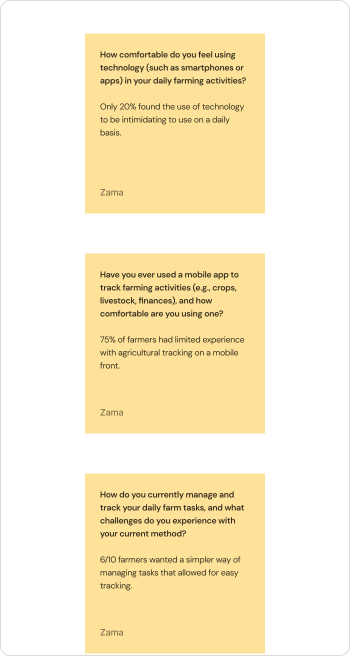
Having a close contact into the world of African Agriculture in the help of real world farmers through Smart Agri. Our team found a smooth journey in getting a deeper understanding into the needs of the farmers that our client wanted to support. I conducted user interviews on the team of SmartAgri farmers to further fledge out the initial requirements that were gathered by the business analyst on our team.
Based on these discussions we found:
Our approach included:
Designing a dashboard to give a quick overview of the farm with a high level status on different activities, crops, locations, fields, tasks and inputs.
Designing the task flow that a farmer would undergo. That included a high level task overview, task details, task actions: update & create.
The team understood that the initial scope was to start small and gradually build up to more high level aspects that can span and reach an even wider market in the African agri space.
SOLUTION
Redesigning the Farmer Dashboard
The dashboard was the first view that any farm user would undergo. The farmer would use the dashboard to make informed decisions on the fields they are working on, the tasks that have been assigned to them, relevant crop and input information.
Upon user testing feedback we found that the farmers were overwhelmed with the overall view of the dashboard and wanted to focus more on the assigned tasks, fields and a simple task analysis.
2. Reducing Cognitive Load in Task Management
Based on the requirements gathered by our team of Business Analysts I found that the task information was fairly extensive in the details that a farmer needed to know in order to fulfill. This caused the initial design to cause cognitive load on the developers and unnecessarily clutter the UI of the app.
With the help of A/b testing on the important variable that was the task list card. This enabled me to come up with a concise view to the task list that not only helped in the cognitive overload for the developers but a simpler view for the farmers too.
3. Iterating the Task Detail Experience
The task details page is the main purpose of the application: where onsite farmers get clear instructions on fulfillment of the task, important input details that inform the management of crops, and submitting proof of task completion, as well as task actions.
This page underwent multiple iterations due to the high volume of information that needed to be relayed to the farmer. It was important for me to keep the designs simple and visually clutter free as multiple user actions were going to be handled on this screen.
CONCULSION
Key Takeaways
Design is long road that takes many turns.
The road to completing our ultimate goal is still in development, and many steps are being taken to get to the finish line of our product. The impact on the first iteration was a perfect eye opener into the development of building an app that is setting out to make a real world impact on the ever growing agriculture space in Africa.
As a designer, making these strides in a space that is so far removed from my everyday landscape, helped me get a better understanding of an important industry that has an immense impact on the continent as a whole.
PREVIOUS
Shesha Design System
Design System | 2023
NEXT
Shesha Design System
Design System | 2023